
Black Gold vs. Golden Grain: Is Guyana’s Agricultural Legacy Slipping Away?
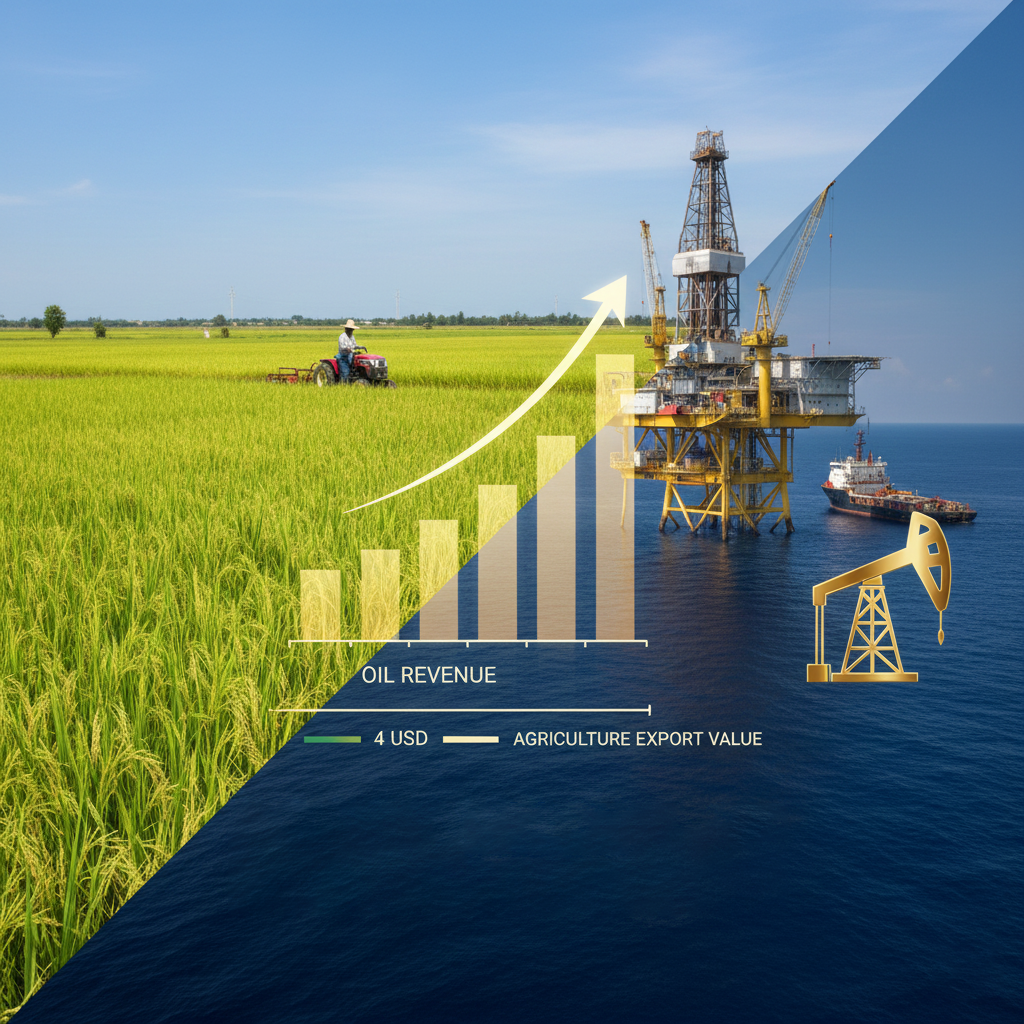
GEORGETOWN, GUYANA — For over a century, the rhythm of Guyanese life was dictated by the harvest cycles of the “King Sugar” estates and the vast, golden rice fields of the Berbice and Essequibe coasts. However, as the roar of the offshore oil rigs grows louder, a quiet anxiety is spreading through the backlands. With Guyana now the world’s fastest-growing economy, many are asking: Are our traditional industries destined to become relics of the past?
The “Dutch Disease” Spectre
Economists call it “Dutch Disease”—a phenomenon where a sudden boom in natural resources leads to the decline of other sectors, particularly agriculture and manufacturing. This happens as the local currency strengthens, making non-oil exports less competitive, and as labor and capital migrate toward the lucrative energy sector.
History is littered with cautionary tales. In the 1970s, Nigeria was a global agricultural powerhouse, providing for its own and exporting to the world. Following its oil boom, the agricultural sector was neglected; today, despite vast arable land, Nigeria is a net food importer. Similarly, Venezuela saw its once-thriving coffee and cocoa industries vanish as the “petro-state” model took hold, leaving the nation vulnerable when oil prices eventually crashed.
By the Numbers: A Tale of Two Realities
The 2025 Mid-Year and Bank of Guyana reports present a complex picture. On the surface, the “traditional” sectors are fighting back with record-breaking production, but the underlying economic pressure is mounting.
The Rice Dilemma: More Work, Less Pay?
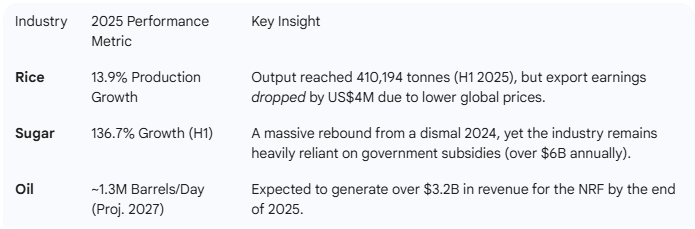
Rice remains Guyana’s most vital agricultural export, but the 2025 data reveals a worrying trend. Despite a 5.5% increase in export volume, Guyana earned US$123.1 million in the first half of 2025—roughly US$4 million less than the same period in 2024. The average export price per metric tonne fell by 8.2% to $547.35.
Farmers in Essequibo and Mahaicony have held protests throughout 2025, lamenting paddy prices as low as $2,800 per bag, which many claim is below the break-even point. While the government has stepped in with a $2 billion modern drying and storage facility and a $300 per bag subsidy, the question remains: Can a traditional sector survive on the “life support” of oil revenues indefinitely?
Sugar’s Bitter Struggle
The sugar industry, managed by GuySuCo, saw a spectacular 136.7% production jump in early 2025, producing 15,954 tonnes compared to a mere 6,739 in 2024. However, this “growth” is relative. The industry is still a shadow of its former self, plagued by high production costs and aging infrastructure.
The government’s strategy is clear: use oil wealth to mechanize and modernize. But as younger Guyanese look toward the high-paying jobs in the oil and gas “Goliath,” the labor shortage in the cane fields is becoming critical.
A Crossroads, Not a Conclusion
The Government of Guyana maintains that it will not let agriculture die. Through the “25 by 25” initiative (aiming to reduce the CARICOM food import bill by 25% by 2025), they are pushing for diversification into “non-traditional” crops like corn, soya, and high-value spices.
The danger is not that rice and sugar will vanish overnight, but that they will become “trophy industries”—kept alive by the state for sentimental and political reasons rather than economic viability. To avoid the fate of Venezuela or Nigeria, Guyana must ensure that oil wealth is used not just to subsidize the past, but to innovate a future where the tractor and the oil rig can coexist.