
Maduro in Custody: U.S. Forces Capture Venezuelan Leader in Dramatic Caracas Strike
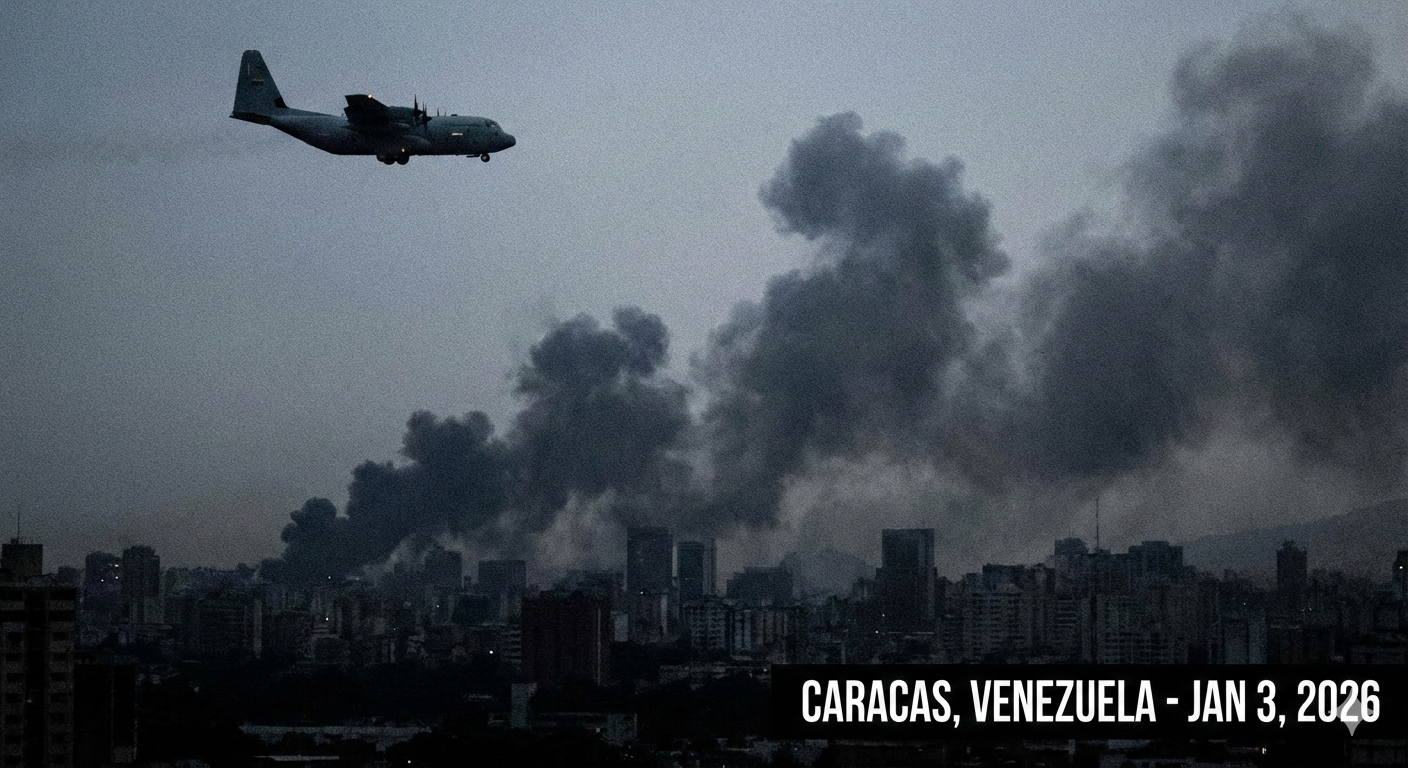
CARACAS / WASHINGTON – In a stunning escalation of military force, United States special operations teams captured Venezuelan President Nicolás Maduro and First Lady Cilia Flores during a massive pre-dawn strike on Caracas early Saturday morning.
President Donald Trump announced the successful completion of the mission, dubbed Operation Southern Spear, in a series of social media posts beginning at 4:30 a.m. ET. He confirmed that Maduro had been “captured and flown out of the country” to face criminal charges on American soil.
The Operation: A Midnight Strike
The assault began around 2:00 a.m. local time when low-flying aircraft and a series of at least seven major explosions rocked the Venezuelan capital. According to defense officials, the operation was spearheaded by the U.S. Army’s Delta Force with support from the 160th Special Operations Aviation Regiment.
Key targets of the “large-scale strike” included:
-
Fort Tiuna: Venezuela’s largest military complex.
-
La Carlota Air Base: Where several vehicles were reported destroyed.
-
Communication Hubs: Strategic antennas and command centers in the Miranda and La Guaira states.
U.S. Secretary of State Marco Rubio indicated that the operation was the culmination of months of “maximum pressure,” citing Maduro’s alleged role in narco-terrorism and the rigging of the 2024 presidential election.
Legal and Judicial Aftermath
U.S. Attorney General Pam Bondi confirmed that both Maduro and Flores have been indicted in the U.S. District Court for the Southern District of New York. The charges center on a long-standing “narco-terrorism” conspiracy, with Bondi vowing they would “face the full wrath of American justice.”
“The United States of America has successfully carried out a large-scale strike against Venezuela and its leader… who has been, along with his wife, captured and flown out of the Country.” — President Donald Trump
Chaos in Caracas
In the wake of the capture, Venezuelan Vice President Delcy Rodríguez demanded “immediate proof of life” for the president, while Defense Minister Vladimir Padrino López appeared in a video message calling for a “united front of resistance.” He declared a “state of external commotion” but did not explicitly confirm Maduro’s whereabouts.
Reports from Caracas describe a city in shock, with the southern districts losing power and residents being urged to shelter in place by the shuttered U.S. Embassy. Meanwhile, in Doral, Florida, large crowds of Venezuelan exiles took to the streets to celebrate, waving flags and chanting “Libertad.”
Global Reaction
The international community has responded with a mixture of support and condemnation:
-
Russia and Iran: Both nations denounced the operation as a “flagrant violation of sovereignty” and “armed aggression.”
-
Brazil: President Luiz Inácio Lula da Silva called the bombardment an “unacceptable line” that creates a dangerous global precedent.
-
United Kingdom: Prime Minister Keir Starmer clarified that the UK was not involved and emphasized the importance of international law.
The U.S. Federal Aviation Administration (FAA) has since issued a total ban on American aircraft in Venezuelan airspace, citing “ongoing military activity.”
A major escalation with echoes of Panama 1989
The operation marks one of the most direct U.S. military interventions in Latin America in decades, drawing comparisons in international reporting to the 1989 U.S. invasion of Panama that resulted in Manuel Noriega’s capture. Financial Times+1
What happens next
In the immediate term, attention is focused on:
-
Who controls Venezuela’s security forces and state institutions after Maduro’s removal;
-
Whether further U.S. strikes or ground operations follow, or whether Washington declares the mission complete;
-
Potential emergency diplomacy at the U.N. and regional bodies, as governments weigh whether the action violated international law or prevented further instability.