
US Navy Monitoring The Disappearance of 16 Sanctioned Oil Tankers Off Guyana’s Coast
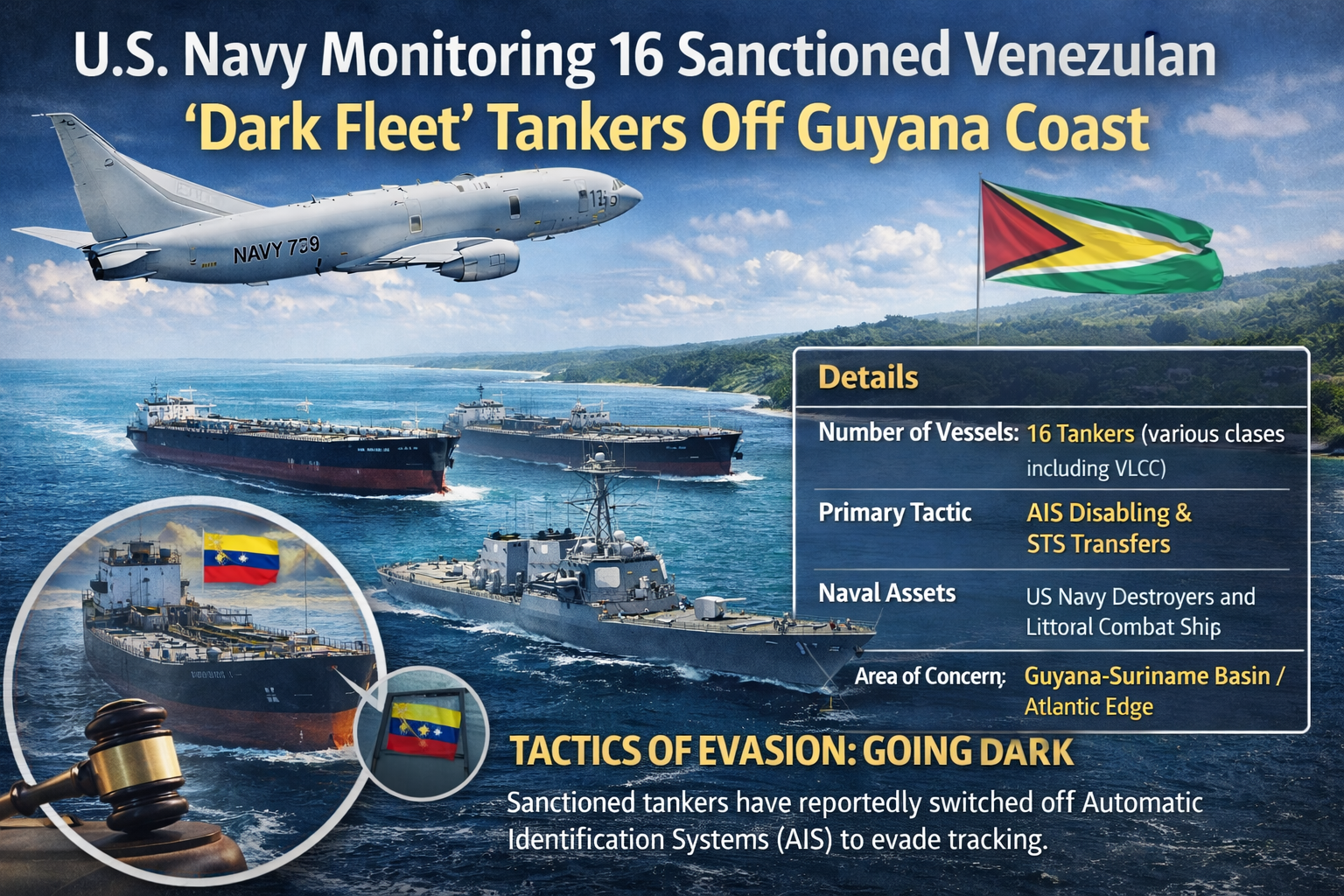
GEORGETOWN, Guyana — The United States Navy has ramped up its maritime surveillance operations along the Guyanese coastline following intelligence reports that a fleet of 16 sanctioned oil tankers linked to Venezuela is attempting to bypass a major American naval blockade.
The vessels, which are under strict U.S. Department of the Treasury sanctions aimed at the Venezuelan energy sector, have reportedly been maneuvering in the Atlantic waters bordering Guyana’s Exclusive Economic Zone (EEZ). Military analysts suggest the fleet is attempting to find “dark” corridors to transport crude oil to international markets, utilizing the busy shipping lanes of Guyana’s burgeoning oil industry as a strategic screen.
Tactics of Evasion: “Going Dark”
U.S. Southern Command (SOUTHCOM) officials have noted a significant uptick in “dark” vessel activity. This occurs when tankers disable their Automatic Identification System (AIS) transponders to hide their location, speed, and heading.
“We are tracking several ‘ghost’ vessels that have gone dark within the last 72 hours,” a senior naval official stated on the condition of anonymity. “The proximity to Guyana’s offshore oil fields creates a complex operational environment, as these sanctioned tankers attempt to blend in with legitimate commercial traffic.”
The 16 tankers are believed to be part of a coordinated effort by the Maduro administration to liquefy assets and bypass the stringent primary and secondary sanctions that have crippled the Venezuelan economy.
Regional Strategic Importance
The choice of the Guyanese coast for this evasion attempt is no coincidence. As Guyana continues its ascent as a global energy powerhouse, the density of tankers and service vessels in the region provides cover for Ship-to-Ship (STS) transfers, a common method used to disguise the origin of sanctioned crude.
A Diplomatic and Security Tightrope
For the Guyanese government, the presence of sanctioned Venezuelan vessels near its waters adds a layer of complexity to the ongoing border controversy with Caracas over the Essequibo region. The U.S. Navy’s presence acts as both a deterrent to sanctions evasion and a visible sign of security cooperation with Georgetown.
The U.S. Navy has deployed several Arleigh Burke-class destroyers and P-8A Poseidon maritime patrol aircraft to monitor the fleet’s movement. While the Navy has not yet engaged in direct interdiction, the mission remains focused on “presence and intelligence gathering” to ensure the integrity of international sanctions.