
“A Dictatorship in the Making”: Charrandass Persaud Launches Blistering Critique of President Irfaan Ali
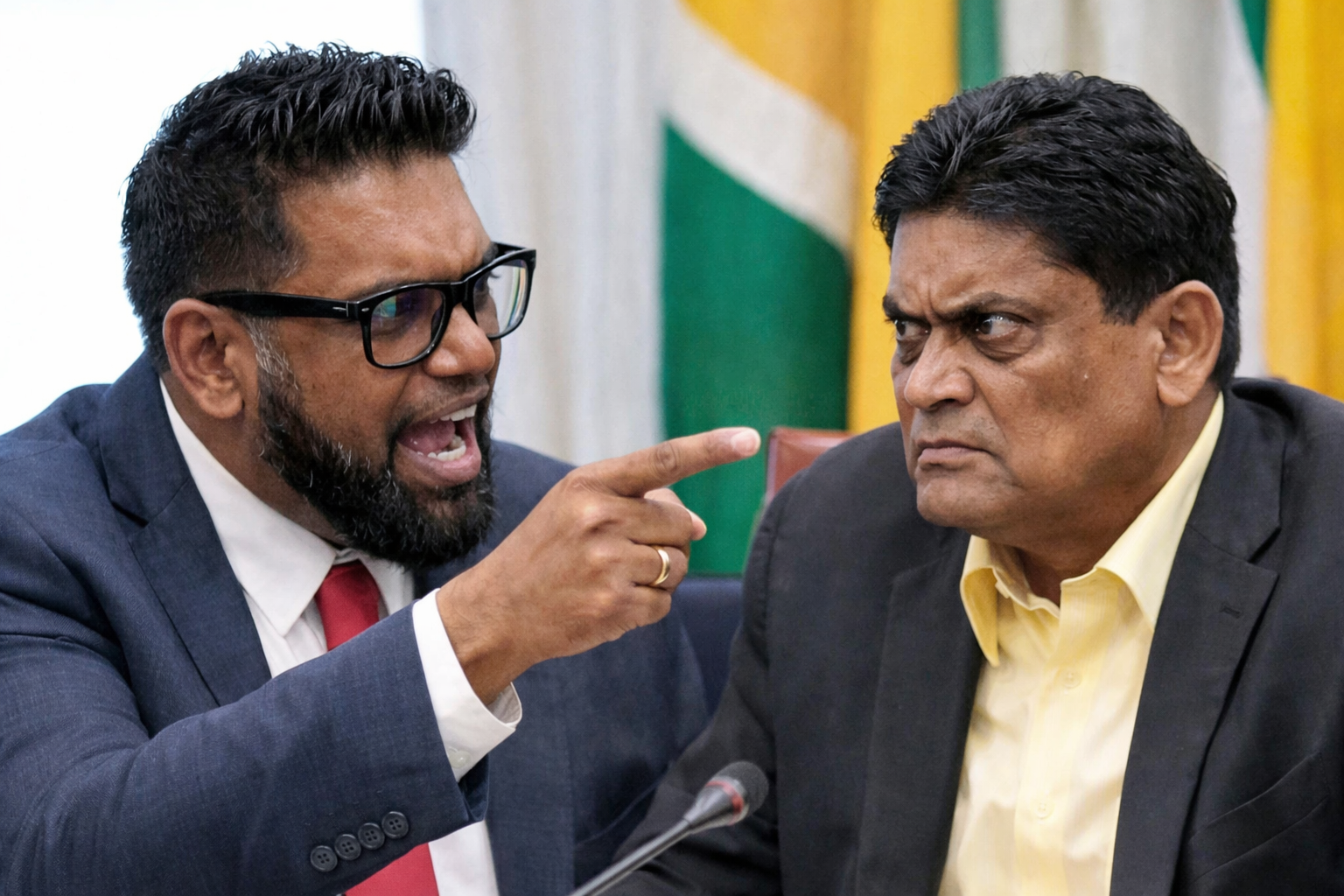
GEORGETOWN, GUYANA — Charrandass Persaud, the former AFC parliamentarian whose single vote famously toppled the APNU+AFC government in 2018, has broken his silence in a viral TikTok address, accusing President Irfaan Ali of abandoning democratic principles and ruling the nation with an “iron fist.”
In a video that has rapidly circulated across social media platforms, Persaud—who previously served as Guyana’s High Commissioner to India under the current PPP/C administration—did not mince words. He characterized the current leadership as a “dictatorship,” alleging that the President and a small inner circle have consolidated power to the detriment of the Guyanese people and the rule of law.
Persaud’s remarks are gaining traction online as Guyana’s political spotlight shifts to a widening dispute over the pace of parliamentary sittings, the continued absence of a formally appointed Leader of the Opposition, and controversy surrounding presidential appointments to the Teaching Service Commission (TSC).
“Dictator” claim framed around governance and oversight concerns
In his message, Persaud ties his “dictator” characterization to what critics describe as weakening checks and balances—particularly Parliament’s role in oversight and the constitutional expectations around consultation for key appointments.
The criticism comes amid reports that the 13th Parliament convened on November 3, 2025, but the National Assembly has not reconvened for regular sittings for months, leaving major legislative business and opposition leadership arrangements in limbo.
Parliament not reconvened; Opposition Leader not appointed
A central flashpoint is the continued non-appointment of a Leader of the Opposition—a position that becomes operationally critical for multiple constitutional processes, including consultations and appointments to commissions.
Local reporting has underscored that the National Assembly’s prolonged pause has coincided with an unresolved opposition leadership question, with concerns raised about the impact on parliamentary oversight.
The Government, however, has pushed back strongly against claims that parliamentary scheduling is being manipulated. President Ali has denied delaying Parliament to stall the election/installation of an Opposition Leader, responding to public questions about the reason for the delay.
Meanwhile, the administration’s allies have publicly rejected claims that Guyana lacks a functioning parliamentary opposition, noting that Parliament is “lawfully constituted” and pointing to upcoming legislative business, including Budget 2026 scheduled for January 26, 2026.
Teaching Service Commission appointments ignite legal and constitutional dispute
Persaud’s critique also aligns with growing controversy over the Teaching Service Commission appointments. On December 31, 2025, President Ali swore in seven members of the TSC for a new term.
Opposition voices and legal challengers argue that Article 207 of Guyana’s Constitution requires meaningful consultation with the Leader of the Opposition for certain TSC appointments—an issue complicated by the current vacancy in that opposition leadership role.
The matter has now moved into the courts. Reporting indicates Dr. Terrence Campbell has filed a legal challenge to quash the appointments, contending that the constitutional consultation standard was not met.
The Government’s position, outlined by the Department of Public Information, is that appointments could not be delayed simply because there is no Opposition Leader, and that constitutional bodies should not become inactive due to that vacancy.
Political temperature rising
Persaud’s “dictator” accusation is among the sharpest political language circulating in the current cycle, and it lands at a moment when public debate is already heated over governance norms, parliamentary momentum, and constitutional process.
With Budget 2026 days away and court action now linked to commission appointments, the coming weeks are expected to bring further confrontation—both in Parliament (once reconvened) and in the legal arena—over how power is being exercised and checked in Guyana.