
A New Front in Guyanese Politics: When Tax Audits Become Political Assassinations
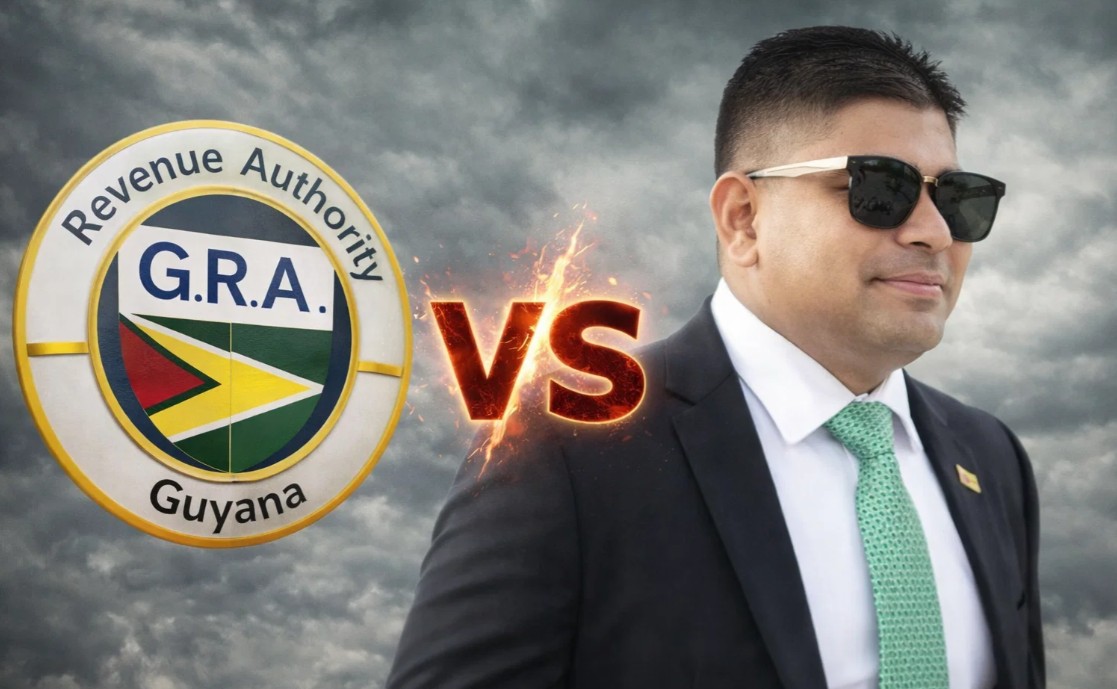
In Guyana, people often talk about “politics” as if it lives only in Parliament, on platforms, or in party meetings. But the truth is simpler—and more serious: politics shows up most powerfully when state institutions start to feel like they are being used as weapons.
That’s why the recent spotlight on the Guyana Revenue Authority (GRA) and Opposition Leader Azruddin Mohamed matters beyond personalities, parties, and even this specific dispute. Mohamed was formally declared Leader of the Opposition in late January 2026, after his WIN party surged into a major parliamentary position. At the same time, he remains entangled in major legal controversy, including a U.S. extradition request tied to allegations of gold smuggling, money laundering, and related offences—allegations he disputes and frames as politically motivated retaliation.
Against that background, the GRA has issued public statements about investigations and potential proceedings involving Mohamed and agency employees related to vehicle transfers and alleged breaches connected to AML/CFT rules and agency procedures. Mohamed, for his part, has publicly challenged the allegations and insisted the transfers were lawful. And in an earlier chapter of this saga, a High Court ruling went in Mohamed’s favour in a high-profile vehicle-tax dispute, with the GRA indicating it would appeal.
Whether you believe the state is enforcing the law properly, or you believe the state is selectively targeting an opponent, the civic lessons are the same—because the danger is not only corruption. The danger is loss of trust in the system that is supposed to treat everyone equally.
Here’s what every Guyanese should take from this moment.
1) Institutions must be strong enough to outlast governments
A government changes. A party rises and falls. But institutions like the GRA are supposed to remain stable, professional, and non-partisan.
When any tax authority is perceived as “political,” two things happen:
-
Supporters of the government start assuming enforcement is automatically righteous.
-
Opponents start assuming enforcement is automatically persecution.
Either way, confidence collapses—and once people stop trusting the tax system, compliance drops, corruption rises, and the country pays the bill.
The lesson: we must defend institutional independence even when we dislike the person being targeted.
2) Due process is the country’s shield—especially for people you don’t like
It’s easy to demand “lock them up” when you think someone is guilty. It’s harder—but far more important—to insist that every action follows clear procedure, lawful authority, and fair process.
This story has bounced between multiple arenas: public statements, the courts, and law enforcement collaboration. That’s exactly where citizens should focus:
-
Is there a clear legal basis?
-
Is the process consistent with how the state treats others?
-
Are the reasons and steps explained transparently—without prejudging guilt?
If due process becomes optional, then nobody is safe—not businessmen, not activists, not small contractors, not teachers, not “ordinary people.”
3) “Selective enforcement” is how democracies rot quietly
Even if an agency’s case is valid, it still matters whether the same intensity applies to everyone else.
The public regularly hears allegations of:
-
under-invoicing,
-
sweetheart arrangements,
-
tax concessions,
-
procurement favouritism,
-
and sudden “interest” in some people but not others.
When enforcement appears to land hardest on political enemies, people start to believe the state isn’t chasing wrongdoing—it’s chasing opponents. Mohamed has repeatedly framed his legal troubles as political retaliation, a claim reported by international outlets. The government side, meanwhile, has publicly rejected the “plot” narrative around his indictment and matters connected to him.
The lesson: justice must not only be done; it must be seen to be done—consistently.
4) Court rulings matter because they are the pressure-test of state power
One of the most important public facts in this broader dispute is that courts have already been involved, including a High Court ruling that went against the GRA in a vehicle-tax matter involving Mohamed, with the GRA indicating it would appeal.
Whether you think the judge was right or wrong, the principle remains:
-
Courts exist to stop agencies from acting outside the law.
-
Agencies exist to enforce the law—within limits.
-
Politicians should not get to “decide” guilt by microphone.
The lesson: we need strong courts, and we need the public to respect rulings even when it hurts their side.
5) If the state can “pressure” a major figure, imagine the ordinary taxpayer
Here is the most practical takeaway for the typical Guyanese:
If the system can move quickly, loudly, and aggressively against a nationally prominent figure—then the same tools can be used against:
-
a small business owner,
-
a minibus operator,
-
a contractor on a government job,
-
a whistleblower,
-
or a citizen who posts the “wrong” opinion.
That doesn’t mean every enforcement action is political. It means the power exists, and power without trusted oversight is always risky.
6) The public must demand oversight that is bigger than personalities
This moment should push Guyanese toward reforms that protect everyone, including supporters of the current government and supporters of the opposition.
Some reforms worth demanding (in principle) include:
-
Transparent enforcement reporting: publish anonymized statistics on audits, penalties, seizures, and prosecutions by category—so the public can see whether enforcement is balanced.
-
Clear public guidelines: how cases are selected, what triggers investigations, how discretionary decisions are controlled.
-
Independent oversight mechanisms: stronger parliamentary review, complaint processes, and protections for whistleblowers.
-
Speedy, accessible appeals: so taxpayers can challenge decisions without being crushed by time and cost.
Because the real goal isn’t to “save” any politician. The goal is to ensure no Guyanese is at the mercy of politics when dealing with the state.
7) Don’t let tribal politics replace evidence
Guyana’s political culture makes it easy to pick a team first and facts later. But this story is exactly where citizens should do the opposite.
Hold these two thoughts at once:
-
A person can be accused of serious wrongdoing and still deserve fair process.
-
A government can claim law enforcement and still be tempted by political advantage. (This is a universal truth, not a Guyana-only problem.)
The lesson: evidence matters more than vibes, and process matters more than propaganda.
The bottom line
The most important lesson isn’t whether you believe Azruddin Mohamed is being unfairly targeted or fairly pursued. The most important lesson is this:
When citizens accept “weaponization” as normal—or accept unaccountable power as “fine” once it hits the other side—democracy dies one exception at a time.
Guyanese should demand a country where:
-
the law is enforced consistently,
-
institutions remain politically neutral,
-
courts are respected,
-
and no government—PPP or otherwise—can treat state agencies as campaign tools.
That’s how you protect the nation, not just one leader.