
Dissecting Loopholes and Fact-Checking the “Generational Wealth” of Susan Rodrigues Financial Defense
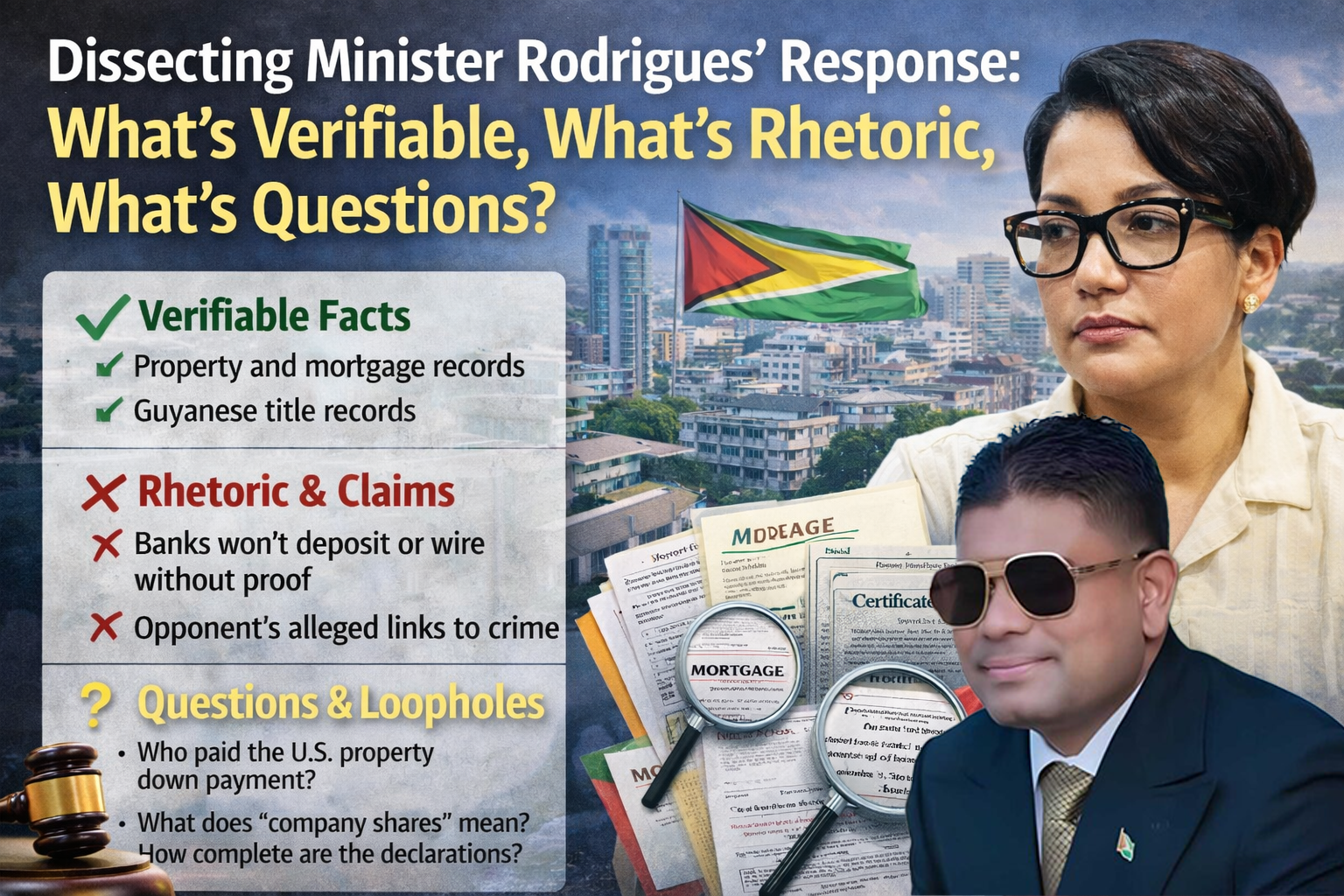
The public confrontation between Guyana’s Minister of Tourism, Industry and Commerce, Susan Rodrigues, and the leader of the WIN Party, Azruddin Mohamed, has escalated into a detailed war of documentation. Minister Rodrigues’ recent Facebook statement aims to dismantle allegations of corruption by providing public records and financial defenses.
However, a closer dissection of her statement reveals a complex tapestry of verified facts, potential loopholes, and legal technicalities that characterize the “Gray Zone” of Guyanese politics.
1. The Florida Property Web: Mailing Addresses vs. Ownership
The Allegation: Mohamed alleged Rodrigues owns three luxury properties in Florida. The Dissection:
-
The Fact: Public records in Florida often list a “Mailing Address” and a “Situs (Physical) Address.” Rodrigues claims two of the addresses are for a realtor and an Honorary Consul.
-
The Loophole: Using a realtor’s home as a “mailing address” for financial or government documents is a common tactic to keep a primary residence off the public record. While it isn’t illegal, it raises questions about why a high-level government official requires a third-party buffer for her overseas affairs.
-
The Admission: Rodrigues admits to being a shareholder in a company that owns the Lauderhill property (8601 NW 46th Ct). By admitting shareholding rather than direct ownership, she utilizes a corporate veil. The loophole here is that the value of her shares and the true nature of the company’s assets remain obscured from the public eye.
2. The “AD Mortgage” Defense: Cash vs. Credit
The Allegation: Mohamed claimed the Lauderhill property was purchased “in full” (cash) on March 11, 2024. The Dissection:
-
The Fact: Rodrigues produced a 2024 tax and interest statement from AD Mortgage. This effectively debunks the “cash purchase” claim, proving that a financial institution holds a lien on the property.
-
The Falsity: Mohamed’s claim of a “full cash” purchase appears false based on the provided documentation.
-
The Loophole: In international money laundering, “sham mortgages” or over-leveraging are sometimes used to “clean” funds by using illicit cash to pay off large mortgage installments rapidly. While the mortgage exists, the source of the funds used to pay the monthly installments (which she claims is rental income) is the secondary point of contention for her critics.
3. The PEP Shield: Is Banking Scrutiny Absolute?
The Argument: Rodrigues argues that as a Politically Exposed Person (PEP), international banks scrutinize her so heavily that corruption is “impossible.” The Dissection:
-
The Fact: Banks do apply “Enhanced Due Diligence” (EDD) to PEPs.
-
The Falsity: The claim that this makes corruption impossible is a logical fallacy. History is replete with PEPs (from the 1MDB scandal to the Pandora Papers) who bypassed EDD through shell companies, offshore trusts, and “nominee” owners. Being a PEP makes corruption harder, but not impossible.
4. The “Operator” Loophole: The Camp Street Gas Station
The Allegation: Rodrigues acquired a prime gas station in Georgetown. The Dissection:
-
The Fact: The land and assets are owned by Shell/Sol Antilles.
-
The Loophole: Rodrigues admits her partner is the operator. In the fuel industry, the “operator” is often the one who realizes the actual daily profit, while the oil major (Sol) simply collects a brand fee or rent. While she technically doesn’t “own” the real estate, her household benefits from the commercial revenue of a prime government-adjacent location.
5. The Legal Safety Net: The Section 351 Advantage
A critical underlying fact in this controversy is the Minister’s personal life. Her partner, often identified in public discourse as Dr. Shanti Singh, is a prominent figure.
-
The Fact: Guyana’s Section 351 of the Criminal Law (Offences) Act criminalizes “gross indecency” between males.
-
The Loophole: Because the law specifically targets men, Minister Rodrigues exists in a “Legal Vacuum.” She can live openly with her partner and hold high office without the threat of the “buggery” laws that are used to marginalize and intimidate gay men in Guyana. Critics argue she “benefits” from a one-sided law that protects women of status while the state maintains colonial-era persecution for others.