
Guyana Navigates the US-Venezuela Power Struggle
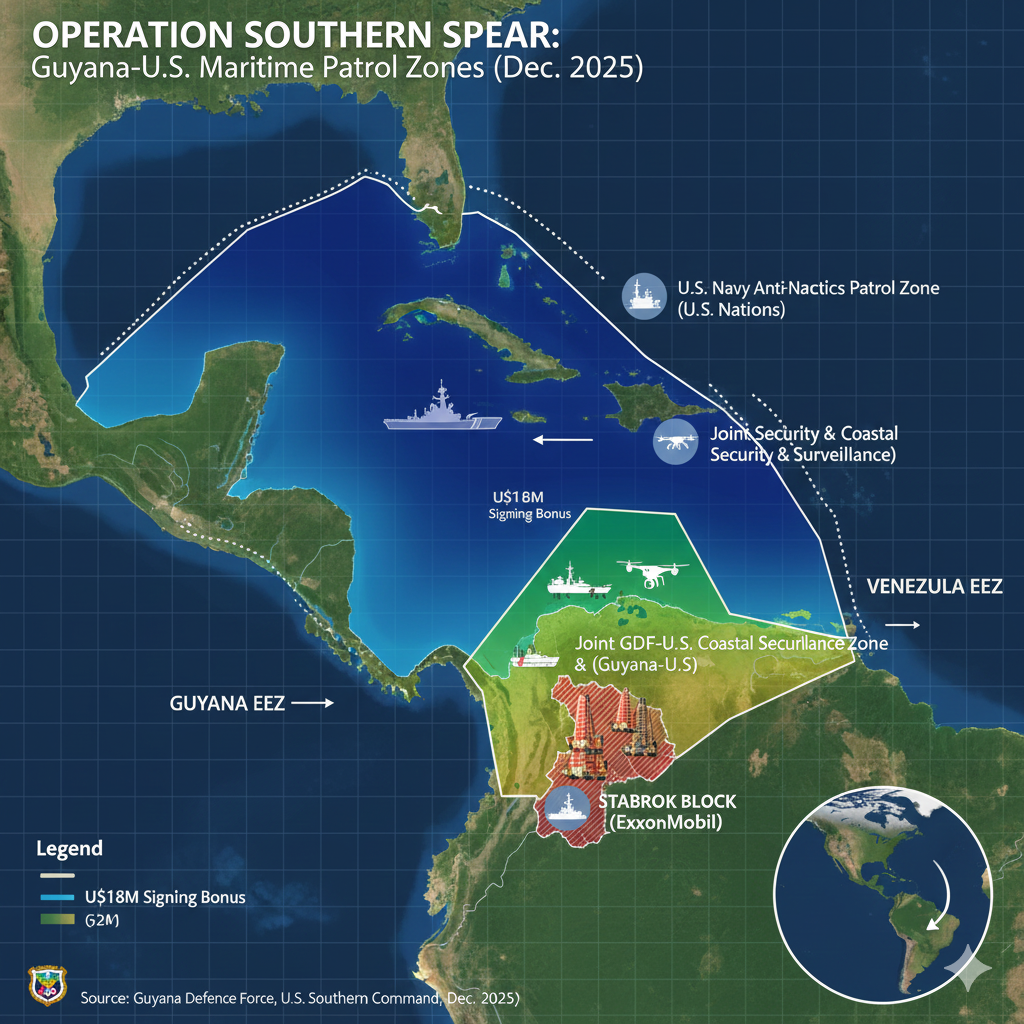
President Dr Irfaan Ali, Commander-in-Chief of Guyana’s Armed Forces, says the country has developed a “comprehensive defence plan and strategy” with international partners to safeguard Guyana and its people if regional tensions worsen amid growing friction between the United States and neighbouring Venezuela.
Speaking to reporters on Wednesday on the sidelines of an event at the Office of the President in Georgetown, Ali was asked what protections are in place should Guyana be caught in a broader confrontation between Washington and Caracas.
“I would not publicly tell you about our defence strategy,” Ali said, “but I can reassure you that with our international partners, we have, over the number of years, developed, and we’ve been working on, a comprehensive defence plan and strategy for our country.”
The President added that he is confident the plan would be effective “with [support from] our international partners,” while praising the Guyana Defence Force and its leadership.
Ali said the government’s security considerations extend beyond Guyana’s borders to citizens living elsewhere in the region, including Guyanese who have historically moved because of instability.
“The safety and security of our country and citizens is always important, wherever our citizens reside,” he said, noting that many Guyanese returned home from Venezuela over the years due to conditions there.
He said that, in the event Guyanese in Venezuela or elsewhere feel the need to return home for safety, “they can expect support of the Government.”
Ali’s remarks come against the backdrop of Guyana’s long-running territorial controversy with Venezuela, which continues to assert claims to more than two-thirds of Guyana’s territory, including the entire Essequibo region. The dispute also extends into Guyana’s Exclusive Economic Zone (EEZ), where offshore oil production has expanded in recent years.
Guyana has repeatedly described Venezuela’s position as spurious and has warned that the posture of the Nicolás Maduro administration remains a central security challenge.
Only two weeks earlier, Ali publicly revisited the threats Guyana faces, describing the regional environment as one in which Guyana must manage both external pressure and domestic safety concerns.
In comments to reporters on December 17, Ali said Guyana’s security outlook is shaped by an “active threat” to the country’s sovereignty and referenced a recent criminal matter involving Venezuelan nationals.
“We just had Venezuelans being charged for terrorist activity in Guyana that claimed the life of [a] young person,” he said. “We have a border situation to manage [whereby] we have an active threat from Venezuela on the sovereignty of this country. And my responsibility is to keep Guyanese safe, to keep Guyana safe, and to work with all our allies and partners in doing that.”
Ali also reiterated support for U.S. military operations near Venezuela that are aimed at countering transnational crime and illicit drug trafficking—activities he said undermine societies across the region.
“My Administration has absolutely no sympathy for drug traffickers,” he said, arguing that smuggling and narcotics trafficking destroy lives and destabilize economies.
Ali framed Guyana’s approach as part of a wider vision for the hemisphere, calling for rule of law, democratic governance, and regional stability.
“We support the region being a zone of peace,” he said, while emphasizing that Guyana intends to continue working closely with allies and partners as tensions and security risks persist.