
Section 351 vs. Minister Susan Rodrigues: Analyzing the Law That Criminalizes Gay Men but Exempts Women in Guyana
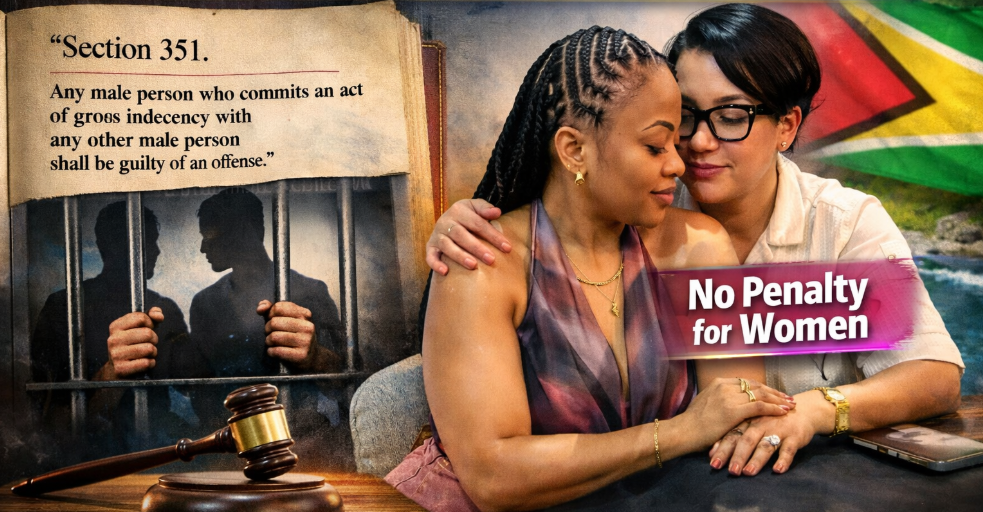
A renewed online debate over “Section 351” and Guyana’s same-sex laws is drawing attention to a key fact: the criminal provision most often cited for targeting gay men is Section 352 of Guyana’s Criminal Law (Offences) Act, Cap. 8:01—and it is written in explicitly gendered terms that apply to male persons only.
What the law says
Under Section 352, the statute states that “Any male person… [who] commits… any act of gross indecency with any other male person” commits an offence.
Because the section is limited to “male person” and conduct with “any other male person,” it is widely described by legal and human-rights organisations as a provision that criminalises male same-sex intimacy, while not creating an equivalent offence framed around women.
Important clarification: In the official text of Cap. 8:01, Section 351 addresses obscene matter, while “gross indecency with male person” appears under Section 352.
Why “exempts women” is part of the controversy
The controversy stems from the law’s wording, not from an explicit statement that women are “exempt.” Section 352 is drafted to criminalise acts involving men, and the law’s structure means the provision does not mirror the same offence language for women.
Rights groups argue that this creates unequal legal exposure and reinforces stigma against gay and bisexual men, even where the provision is reportedly not frequently enforced in modern times.
Where Minister Susan Rodrigues fits into the public discussion
The debate has also referenced Susan Rodrigues, a senior government minister, after public reporting in 2025 quoted her discussing administrative changes intended to reduce barriers for LGBTQ+ couples seeking government services.
In coverage of a political town hall on LGBTQ+ issues, Rodrigues was quoted saying her ministry changed application procedures so couples could identify a “partner or co-applicant” without having to “declare or justify” the relationship.
Those statements have been cited by supporters as evidence of inclusion efforts, while critics argue that administrative adjustments should be matched by legislative reform to remove criminal provisions that explicitly target male same-sex intimacy.
Corruption Allegations and the “Florida House”
The legal debate has been compounded by a series of high-profile corruption allegations spearheaded by Azruddin Mohamed, leader of the “We Invest in Nationhood” (WIN) party, and social media activist Melissa Atwell (known as Melly Mel).
The allegations, which the Minister has vigorously denied, include:
-
The Florida Property: Claims that Rodrigues owns a shell company in the United States which holds a luxury home in Florida valued at US$116 million (or approximately GY$24 billion).
-
Land Grabbing: Allegations that during her previous tenure at the Ministry of Housing and Water, she “grabbed” prime state land for private investment, specifically in the Peters Hall development area.
-
Generational Wealth Claims: In response to questions about how a minister earning a monthly salary of $1.2 million could afford such assets, Rodrigues stated, “I come from money,” asserting that her wealth is generational and fully declared to the Integrity Commission.
The opposition coalition, APNU, has joined WIN in calling for Rodrigues’ immediate resignation. They argue that the “speed and scale” of her wealth accumulation warrants a forensic audit. “Public officials are required to meet a higher standard,” stated an APNU release on January 5, 2026.
The government has so far stood by the Minister, with President Irfaan Ali dismissing the claims as “political character assassination” by individuals facing their own legal troubles.